-
History Of Abacus
-
The word Abacus is a Latin word, derived from a Greek word ‘abax’ or ‘bacon’ which means ‘tabular form’. The plural ‘abaci’ is possibly derived from a Semitic word, ‘abaq’ which means ‘sand’.
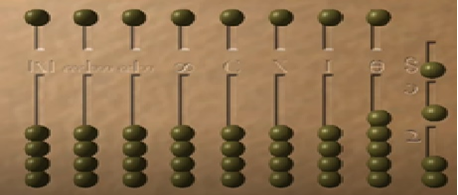
The invention of Abacus- Abacus is the most primitive form of calculating device which was invented somewhere between 300-500 BC, this has travelled a long way and had undergone a lot of transitions as it had travelled through different countries over the world.
-
-
How did it work? Earlier Abacus was used entirely as a calculating machine. An Abacus is almost like a manual calculator with sliding beads, which represents a number. Every single bead generally depicts a value starting from the units’ place moving towards the left to the increasing value. The beads in the upper deck had different values than those of the lower deck. The calculating process requires the usage of both the hands of a person. All the calculations are usually based on the movements of the beads. This greatest invention of the ancient days had helped many merchants and traders in their account matters.
How Abacus came into existence?
Evolution of Abacus:
It is not properly known, when did the calculating devices were developed, but gradually the loose objects were replaced with the regular beads in columns that can slide along the parallel rods.
Who Invented Abacus?
-
The initial information that is obtained about abacus, comes from a Greek historian, Herodotus. The ancient abacus is known as the Salamis abacus.
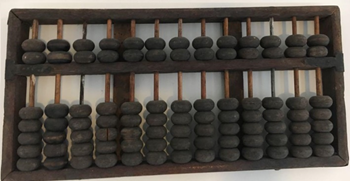
The Chinese invented an improved model of the abacus in 500 BC, which was also known as the Suapan abacus and was used as one of the most primitive forms of calculators. The first-century sources provide evidence that abacus was used by the Indians including a separate column that counted digits with ‘Zero’. Although, history still searches for facts to get proper evidence on the invention of the abacus.
-
-
The Salamis tablet (300 BC) used by the Babylonians marks the oldest counting board as discovered till today. Then came the Roman and Greek abaci, which had different inclination and presentation, but the same purpose. With time, we find different changes in the forms of abaci. Later on, it was adapted in the countries of China, India, Korea, Persia, Rome, Japan, and Russia.
The Suanpan abacus, the modern age abaci which due to its complexity, is replaced by the Soroban abacus, developed in Japan, by a famous mathematician named as, Seki Kowa who has removed one bead each from the upper and the lower decks to make it into 1/4 decks, rather than the 2/5 decks as developed in China.
Abacus Today:
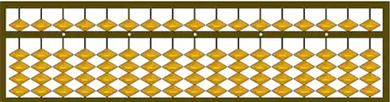
Abacus has gone through many transitions over the years. The Suapan abacus is replaced for its complexity to the abacus that we use today is the Soroban abacus. It has gained popularity competing among various countries on a common platform after Globalization. It has generated a great impact on the educational system today.